The Examiner’s Mindset Method
Why line-by-line beats every summary —
every single time.
CBSE’s competency-based pattern rewards students who can read a text and say something original about it. This is the method that builds exactly that — and nothing else.
The belief
English should be taught in English.
Most resources teach English through Hindi — which quietly builds a dependence on translation instead of the ability to think in the language. Students then develop fear and anxiety not because English is beyond them, but because of rote learning, confusing explanations and a lack of meaningful practice.
“With the right guidance, every student can understand English, communicate confidently, and excel in their boards. The failure is in how it’s taught — never in the child.”
How it works
Three devices. One fluent reader.
1 · Full immersion, zero jargon
Every explanation happens in simple, clear spoken English — an authentic second-language acquisition environment, not a lecture in Hinglish. Slowly, you stop translating in your head. You start thinking in the language you’ll be examined in.
That shift is what makes your writing sound like you — the single quality board evaluators reward most.
“Look at the word ‘stood firm’ — the
astrologer isn’t just talking. He is refusing
to bend before a king. That’s courage —
and the author wants you to notice it.”
On screen, as you watch
the word stays English — the meaning never blocks you
2 · The bilingual safety net
The moment a Tier-2 word appears — satire, legacy, resilience — its precise Hindi meaning is glossed on the margin of the screen. Lower-proficiency students get an instant lifeline without breaking the English immersion.
The result: a growing personal lexicon, learned in context. Not a translated summary that evaporates in the exam hall.
3 · The rubric, embedded live
Board-level competency questions and extract-based questions aren’t saved for “revision later” — they’re asked inside the reading itself, at the exact line they come from. You watch an answer get built straight from the prose, to the marking criteria evaluators actually use.
Demystify how the script is marked, and the panic goes with the mystery.
Value points: quotation lifted correctly · device named · effect explained in own words.
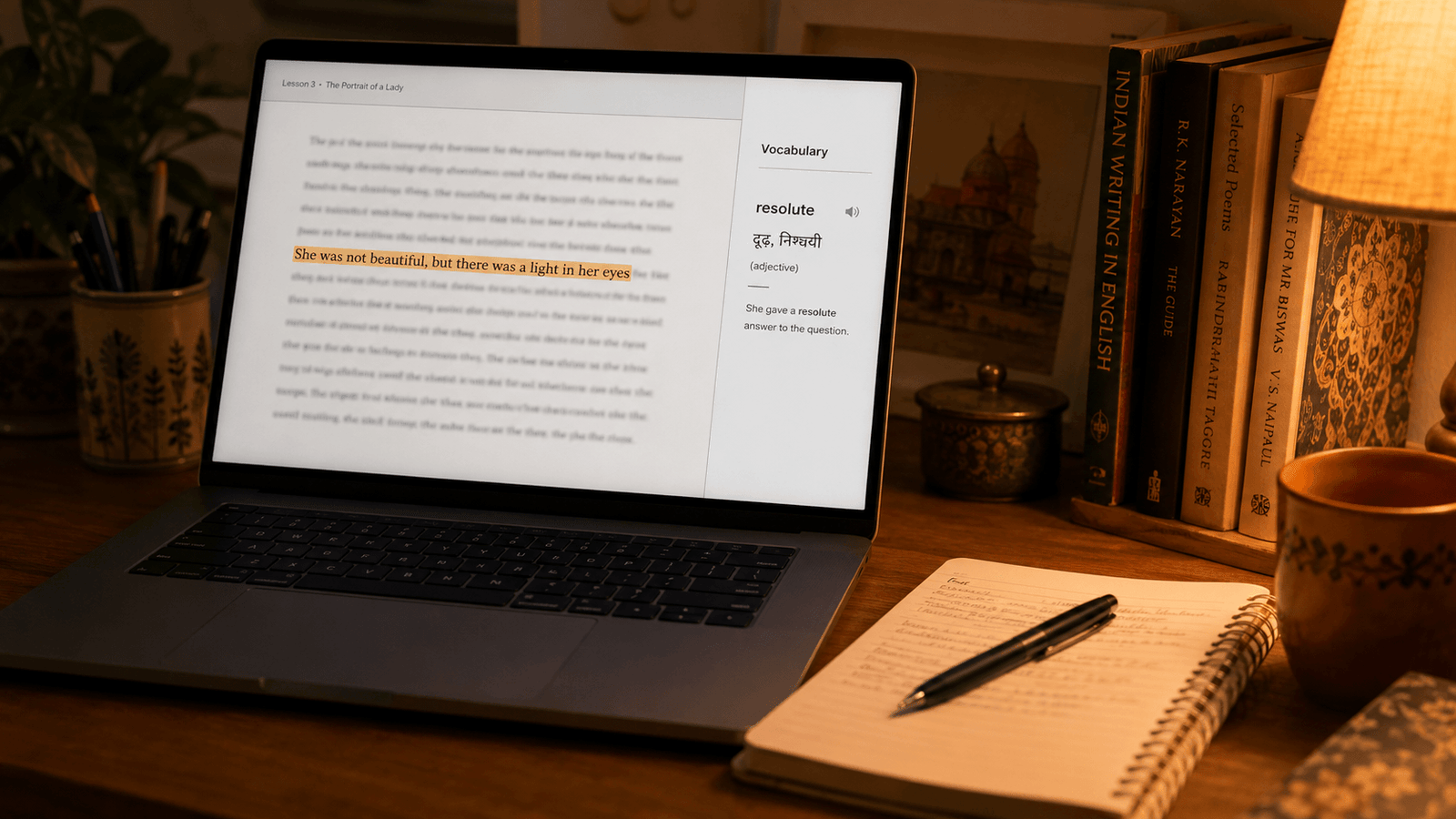
What it actually looks like, mid-class
The highlighted line, the gloss panel, the question waiting at the margin — all three devices on screen at once, exactly as a student sees them live.
Inside one class
Fifty minutes, engineered.
The hook, not the biography. Long author histories are compressed into one high-impact visual hook — then we get straight to the text.
Line-by-line decoding. Tone, subtext, irony, register — spotted, named and articulated in your own words, with vocabulary glossed live and CBQs answered at the line they arise from.
The answer, framed. The day’s reading becomes a structured board-style response — the blueprint you’ll practise on your worksheet.
What’s deliberately cut: passive plot re-tellings and 40-minute author biographies. If it doesn’t move your marks or your language, it’s gone.
The quiet advantage
Calm is taught here, too.
Board performance is half preparation, half nerves — and almost nobody teaches the second half. Your mentor is a certified guidance & counselling professional and a contributor to Manodarpan, the Government of India’s student-wellbeing initiative.
So exam anxiety isn’t dismissed with “just practise more.” The pacing, the questioning, the feedback — the classroom is designed around how a stressed seventeen-year-old actually learns.
- The mystery removed: when you know how the script is marked, the fear has nowhere to live.
- Confidence by evidence: your own marked answers become proof you can do this.
- A steady voice: feedback that corrects the answer without crushing the student.
Behind Examiner’s Lens
Built by someone who helps build the system.
We don’t lead with a name or a face — we lead with what happens to your marks. Here is the experience doing the teaching.
Deep in the classroom
27 years as a CBSE Postgraduate Teacher of English · 15,000+ students taught and mentored across secondary and senior-secondary stages.
Deep in the system
National English subject-matter expert · course reviewer on DIKSHA · resource person for CIET webinars, PM e-Vidya and Swayam Prabha broadcasts.
Recognised for it
PhD in English · Fulbright Teacher Exchange awardee (2019–20) · National Award to Teachers (regional level) · 220-hour international TESOL/TEFL diploma · Google Certified Educator L1 & L2.
A mentor who has taught the syllabus, trained the teachers, and helped write the training itself — now teaching your chapter, line by line.
Watch the method work on a real chapter.
One free demo class. No pitch theatre — just teaching.